Building a custom home is one of the most significant decisions a family can make — and one of the most misunderstood. Most people have a mental picture of it based on what they've seen on TV or heard secondhand: it's complicated, stressful, full of surprises, and over budget. The reality, when you're working with the right builder, is very different.
This guide walks you through the entire home building process from first conversation to move-in day, in plain language, so you know what to expect at every phase. No surprises. No fine print. Just an honest picture of what building a custom home in Northeastern Pennsylvania actually looks like in 2026.
"The families who feel most confident about building aren't the ones with the most experience — they're the ones who took time to understand the process before they started."
The Home Building Process: Step by Step
Initial Consultation & Lot Assessment
Everything starts with a conversation. You'll meet with your builder to talk through your vision — how many bedrooms, what style of home, must-haves vs. nice-to-haves, and budget range. If you don't already have land, this is when you discuss lot options. If you do have land (or a specific parcel in mind), the builder will assess it: access, topography, soil conditions, utility availability, and any zoning restrictions that affect what can be built.
- Share your priorities and lifestyle needs
- Establish a realistic budget range
- Evaluate lot suitability (if land is already identified)
- Discuss municipality and zoning requirements
- Understand well & septic requirements (if applicable)
Design, Floor Plan & Selections
Once you're aligned on budget and lot, the design work begins. You'll work from either a base floor plan (which can be customized extensively) or start from scratch. This phase is where your home starts to take shape on paper — room layouts, exterior style, garage configuration, window placement, and all the elements that make the home yours.
After the floor plan is approved, you'll move into selections: exterior materials, roofing, windows, interior finishes, cabinetry, flooring, fixtures, and more. A good builder will guide you through this systematically so decisions are made in the right order without feeling overwhelming.
- Floor plan review and customization
- Exterior elevation and style decisions
- Structural decisions (foundation type, garage, bonus rooms)
- Interior finish selections (flooring, cabinets, counters, fixtures)
- Mechanical rough-in decisions (HVAC type, electrical panel location)
- Final contract and specifications document signed
Financing & Construction Loan
Building a home requires a different financing structure than buying a resale. Most buyers use a construction-to-permanent loan (also called a one-time close or C2P loan) — a single loan that funds the build in draws as work progresses, then automatically converts to a traditional mortgage at completion. Some buyers use a two-stage process: a separate construction loan, then a refinance into a permanent mortgage at the end.
Either way, your lender will require a complete set of plans, specs, and a builder contract before approving. Work with a lender who has experience in new construction — the process is more involved than a standard purchase, and an inexperienced loan officer can slow things down significantly.
During construction, you typically make interest-only payments on the amount that's been drawn (paid out to the builder). You don't pay on the full loan amount until the home is complete and the loan converts. Most C2P loans have a construction period of 12–18 months.
Permits & Site Preparation
Before any ground is broken, permits must be obtained from the local municipality. In Pennsylvania, this means submitting engineered drawings to the township or borough building department. Permit timelines vary significantly by municipality — some smaller townships process in a few weeks, while larger boroughs can take 8–12 weeks or more. Your builder handles this process, but it's important to factor it into your overall timeline expectations.
While permits are in process, site prep work often begins: clearing and grading the lot, staking the foundation footprint, and coordinating utility connections. If well and septic are required, drilling and testing typically happens during this phase as well.
- Building permit application submitted
- Township review and approval (timeline varies)
- Well drilling and water testing (if applicable)
- Septic system design approval (if applicable)
- Lot clearing and rough grading
- Underground utility stubs (electric, gas, cable)
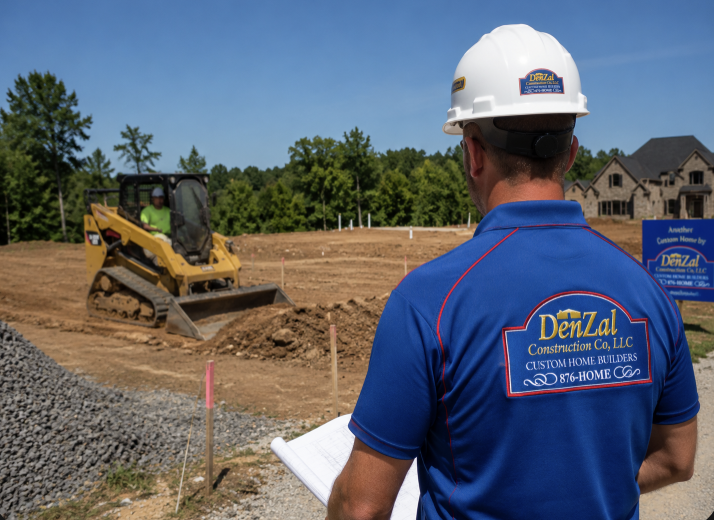
Site preparation — where your land becomes the foundation of something new.
Foundation
Once permits are approved and the lot is prepped, construction begins with the foundation. Depending on your design, this will be a full poured concrete basement, a crawlspace, or a slab-on-grade. In NEPA, full basements are the most common and most practical choice — they add usable square footage and provide protection from the region's frost depths.
Foundation work includes excavation, footings, waterproofing, drainage, and backfill. It looks deceptively fast from the outside — but it's the most critical phase structurally. Everything that comes after depends on the foundation being right.
- Excavation and footing forms
- Concrete poured for footings and foundation walls
- Waterproofing membrane and drainage tile
- Inspection by township building inspector
- Backfill and rough grading around foundation
Framing
Framing is the most visually dramatic phase of building — it's when your home literally takes shape out of the ground. The floor system, exterior walls, interior partitions, and roof structure all go up during framing. At the end of this phase, you can walk through your home for the first time and see how every room connects. It's a milestone most families remember.
In Pennsylvania, framing crews work through most weather conditions — though heavy rain, high winds, or snow can cause short delays. Lumber is the primary material, and your builder will use engineered lumber products (LVL beams, I-joists) for long spans and load-bearing applications where dimensional lumber isn't sufficient.
- First-floor decking and wall framing
- Second-floor (if applicable) framing
- Roof trusses or stick-frame roof structure
- Sheathing (walls and roof)
- House wrap (weather-resistant barrier)
- Framing inspection
Mechanicals: Plumbing, Electrical & HVAC
After framing is inspected and approved, the mechanical trades move in. Plumbers rough in the supply and drain lines. Electricians rough in wiring runs, panel location, and rough box locations. HVAC contractors install ductwork, equipment platforms, and rough-in for the heating and cooling system. These three trades work in sequence (and sometimes overlap) inside the open walls and ceilings before insulation and drywall close everything in.
Each trade requires its own inspection and sign-off before drywall can proceed. Don't be surprised if your builder schedules multiple inspector visits during this phase — it's normal, and it's the right way to do things. Changes to mechanical layouts after drywall are expensive; this is when to ask questions.
- Plumbing rough-in (supply, drain, vent)
- Electrical rough-in (panel, circuits, boxes)
- HVAC ductwork and equipment rough-in
- Low-voltage rough-in (cable, data, security)
- Rough-in inspections by township
Insulation, Drywall & Exterior
Insulation goes in after all mechanicals are inspected — walls, attic, and any sound-insulation areas you've specified. Then drywall (also called sheetrock or wallboard) is installed, taped, mudded, and sanded. The drywall phase transforms a framed shell into something that starts to feel like a home.
Simultaneously, exterior finishes are being completed: roofing shingles, siding or stone, windows and exterior doors, exterior trim, and any masonry work. Once the home is weathertight and the exterior is finished, interior work can proceed in all weather.
- Batt and spray foam insulation installed
- Drywall hung, taped, and finished
- Roofing (shingles, flashing, gutters)
- Siding, stone, or masonry exterior finish
- Windows and exterior doors set
- Exterior trim and soffit/fascia
Interior Finishes
This is the phase where your selections come to life. Interior doors and trim go in. Cabinets are installed in kitchen and baths. Countertops are templated and fabricated. Flooring — hardwood, LVP, tile, carpet — is installed. Paint goes on the walls. Fixtures, hardware, and light fixtures are installed. Plumbers and electricians return to finish out their work (trim-out).
The interior finish phase is the longest interior phase, and it's the one most affected by material lead times. Cabinets, countertops, and tile are typically ordered during the design phase so they arrive when needed. If you change your selections late in the process, it can cause delays — one of the key reasons to lock in your choices early.
- Interior doors, casing, and trim
- Cabinetry installation (kitchen, baths, laundry)
- Countertop templating and installation
- Tile work (showers, backsplash, floors)
- Hardwood, LVP, and carpet flooring
- Paint (prime and finish coats)
- Plumbing trim-out (fixtures, faucets, toilets)
- Electrical trim-out (devices, fixtures, panel labeling)
- HVAC trim-out (registers, thermostats, equipment start-up)
Final Inspections, Certificate of Occupancy & Walkthrough
Before you move in, the township or borough must inspect the completed home and issue a Certificate of Occupancy (CO). This confirms the home was built to code and is safe to inhabit. Your builder coordinates all final inspections — building, electrical, plumbing, and HVAC.
Once the CO is issued, you'll do a final walkthrough with your builder. This is your opportunity to identify any items you want addressed — paint touch-ups, trim adjustments, hardware that needs tightening — before closing. A good builder will provide you with a written punch list and complete all items before handing over keys.
- Final building inspection and CO issuance
- Utility company meter sets (electric, gas)
- Driveway and final grading
- Landscaping (grading and seeding, per contract)
- Final owner walkthrough and punch list
- Punch list items completed
- Closing on permanent mortgage (C2P conversion)
- Keys in hand — move-in day
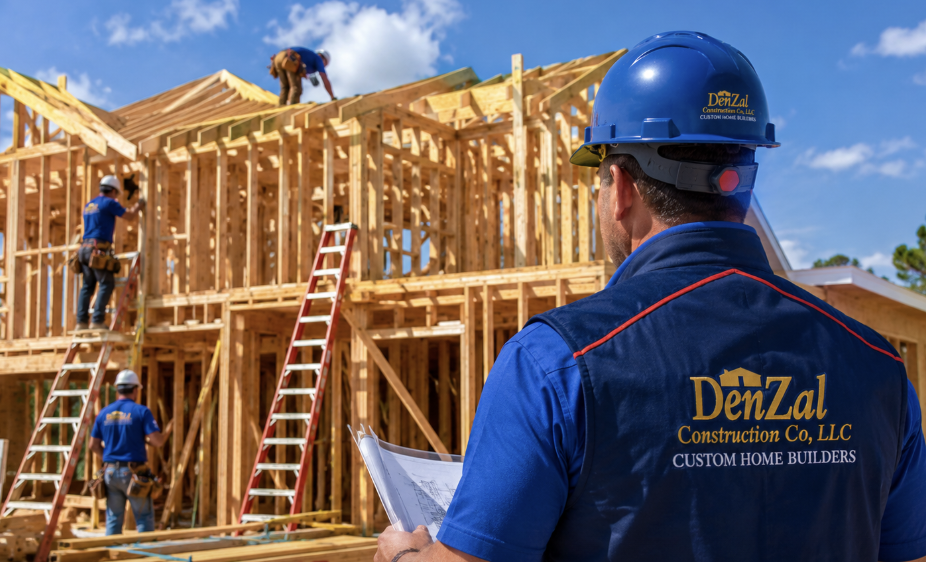
Every board, every beam — your home taking shape exactly as planned.
What Buyers Ask Most Often
How to Set Yourself Up for a Smooth Build
The families who have the best building experiences — the ones who cross the finish line with a great home and a great relationship with their builder — aren't necessarily the ones with the biggest budgets. They're the ones who came in prepared. Here's what that looks like in practice:
- Get pre-approved for a construction loan before committing to a builder or lot
- Define your must-haves vs. nice-to-haves in writing — prioritized order
- Understand your all-in budget (construction + land + well/septic + contingency)
- Budget a contingency of 5–10% above your contract price for changes and surprises
- Lock in all selections before construction starts — avoid mid-build change orders
- Read your contract fully — understand the draw schedule, change order process, and warranties
- Know your permit timeline for your specific municipality before setting a move-in target
- Establish a clear communication cadence with your builder (weekly updates, preferred method)
- Plan your living situation through the full construction window — don't assume it'll finish early
- Visit the job site at key milestones with a checklist — foundation, framing, mechanicals, final walk
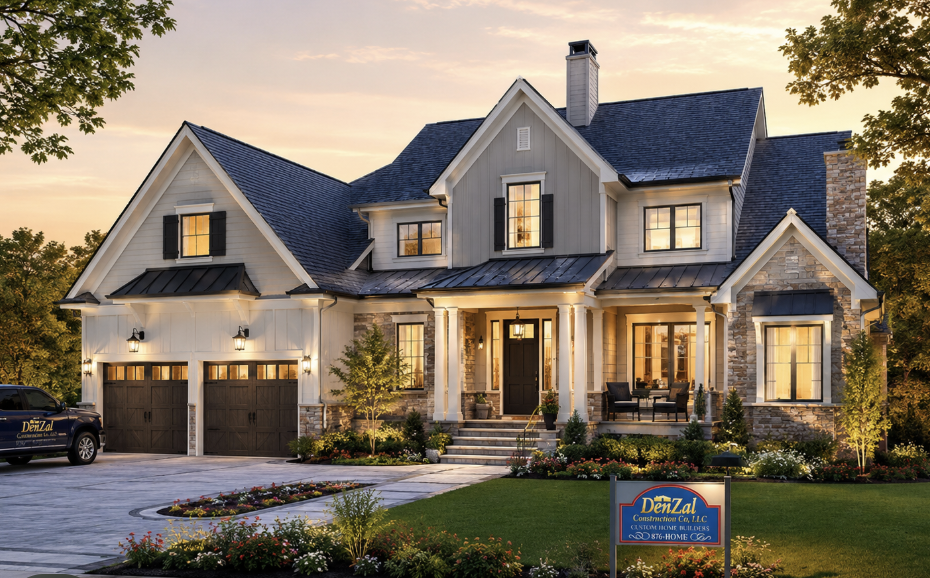
From empty lot to finished home — built for the family who lives in it.
Building in NEPA: What Makes It Different
Building a custom home in Northeastern Pennsylvania has some specific considerations that families should understand before they start:
Pennsylvania's Uniform Construction Code (UCC)
Pennsylvania administers building permits at the municipal level under the state UCC. That means permit timelines, inspector availability, and review processes vary significantly from one township or borough to the next. A permit in a small rural township might come back in three weeks. The same submission in a larger borough might take three months. Your builder should know the permitting landscape for your specific municipality and set your expectations accordingly.
Seasonal Considerations
NEPA winters affect exterior construction work — concrete pours, masonry, and foundation work have temperature limits, and roofing and exterior finish work slows in snow and ice. A smart build timeline accounts for the season. Starting a foundation in November is possible with the right precautions; starting it in October so you're framed before December is better. Builders who work in NEPA year-round know how to sequence work to minimize seasonal impact.
Well & Septic in Rural Areas
Many desirable lots in NEPA — especially in the Back Mountain, Endless Mountains, and rural Lackawanna and Wayne County areas — require private well and septic systems rather than public utilities. Well drilling timelines and septic design approvals (through the county) can add 6–10 weeks to your pre-construction phase. Budget $30,000–$55,000 for both systems combined, and don't assume water quality or septic suitability without testing first.
Township Variance and Zoning
Setbacks, lot coverage limits, height restrictions, and permitted uses vary by zoning district. Before committing to a lot, confirm with your builder that your planned home fits within the zoning envelope for that parcel. A variance (an exception to standard zoning rules) is sometimes required for unusual lots — they're obtainable but add time and cost. Know this before you're committed.
The Bottom Line
Building a custom home is not a mystery — it's a process. It has a defined sequence of phases, each with its own timeline, its own tradeoffs, and its own set of decisions. The families who go into it with a clear picture of what to expect are the ones who come out on the other side with exactly the home they wanted.
The most important decision in the entire process is choosing your builder. A builder who communicates clearly, manages subcontractors well, solves problems before they become your problem, and delivers what they say they're going to deliver — that builder makes the entire experience what it should be. Ask for references. Visit completed homes. Understand the contract. Then build.
DenZal Construction Co. LLC has been building custom homes across Northeastern Pennsylvania for years. If you're thinking about building and want a straight conversation about what it would look like for your family, your land, and your budget — we're ready when you are.